
How to Cook the Perfect Steak at Home: The Heat, The Science and The Secret

The Common Home Steak Struggles
Cooking steak at home sounds simple. Season, sear, serve, right?
But for many home cooks, the results fall short of expectations. The inside is too raw, or worse, the steak ends up dry and grey. The outside fails to form that signature crust, or your entire kitchen fills with smoke before dinner even hits the plate.
It’s not your fault. The truth is, most home kitchens simply aren’t equipped with the kind of heat firepower chefs rely on to achieve restaurant-quality steaks. But before we get into that, let’s break down what actually makes a steak great.
What Makes a Perfect Steak?
There’s a reason steak is a centrepiece dish. When done right, it delivers a textural contrast that’s hard to beat: a caramelised crust with a tender, juicy interior.
A perfect steak checks these boxes:
Even doneness throughout, from edge to centre
Rich crust from the Maillard reaction (a form of browning that creates complex flavour)
Juice retention, without drying out the meat
Precise control over doneness: rare, medium-rare, medium, medium-well or well-done
Achieving this balance requires more than just good timing. It requires understanding how heat interacts with muscle, fat and moisture inside the meat.
The Science Behind Steak Doneness

Steak changes dramatically as internal temperature rises:
Doneness:
Rare
Internal Temp: ~50°C
What Happens Inside: Muscle proteins just begin to denature, steak is soft and red
Medium-Rare
Internal Temp: ~55°C
What Happens Inside: Myoglobin darkens, fibres firm slightly, maximum juiciness
Medium
Internal Temp: ~60°C
What Happens Inside: More proteins contract, juices begin to redistribute
Medium-Well
Internal Temp: ~65°C
What Happens Inside: Noticeable moisture loss, firmer texture
Well-done
Internal Temp: ~70°C+
What Happens Inside: Proteins fully contracted, dry and chewy texture
At the same time, surface temperature needs to hit at least 150°C to trigger the Maillard reaction, the browning that gives steak its deep, umami flavour. That’s why simply baking a steak won’t cut it. You need intense heat at the surface, and gentle control inside.
How Restaurants Really Do It
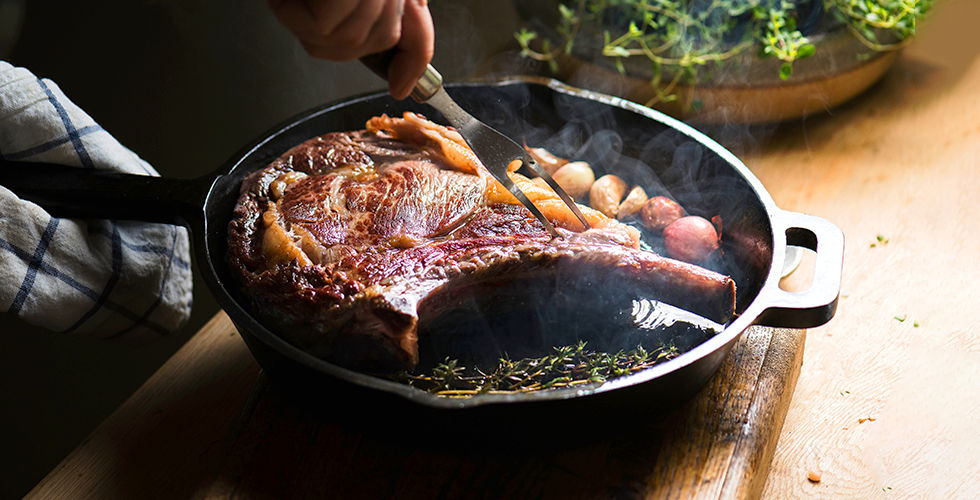
Chefs rely on powerful equipment that can hit temperatures upwards of 600°C to 700°C. This lets them:
Sear the steak instantly, creating that crisp, flavourful crust
Lock in juices quickly, reducing moisture loss
Control doneness using a brief high-heat sear followed by resting or gentle finishing
In professional kitchens, this might involve salamander grills, charcoal setups or cast iron pans heated beyond what most home cooktops can manage.
And that leads us to the real challenge: how to replicate this at home.
Replicating at Home

Pan-searing is the go-to method, but it comes with caveats.
Option 1: Pan-Searing Only
Pros: Fast, intense heat, forms crust
Cons: Risk of overcooking, uneven doneness, smoke-filled kitchen
Pan-searing requires careful timing. Just a few seconds too long, and your rare steak turns medium. You also need to ventilate well or risk setting off your smoke alarm.
Option 2: Oven-Roasting Only
Pros: Gentle, even doneness
Cons: No crust, less flavour development
The oven does well in managing internal temperature but lacks the intense surface heat needed to caramelise the exterior. This often results in a pale, bland steak unless you finish it with a sear.
Option 3: Pan-to-Oven Method
This is the gold standard for most home cooks:
Sear both sides in a hot pan
Transfer to a preheated oven to finish cooking
It’s effective, but not foolproof. You still need to time everything perfectly. Plus, it requires multiple tools and a fair bit of cleaning up.
Pros: Balanced result
Cons: Multi-step, timing-sensitive
The Secret to Perfect Steak at Home: Teka SteakMaster Oven Explained

Enter the Teka SteakMaster. Designed for steak lovers, it is the only oven in the world with a built-in grill that reaches 700°C.
That’s not a typo. Seven hundred degrees.
At that temperature, you can achieve a professional-grade sear in just two to three minutes, locking in juices while keeping the inside at your desired doneness. The SteakMaster even comes with pre-set doneness programmes, so you can choose your steak style and let the oven do the rest.
For the perfectionist and the practical alike, the SteakMaster delivers restaurant-quality results in your own kitchen.
We’re not saying it’s the only way to cook a great steak. But if you love steak, it might just become your favourite way.
Want to See It in Action?

Experience the Teka SteakMaster at our Singapore Experience Centre, or explore full details on the SteakMaster page.


Comments